
How to Relax in Front of the Camera During a Japan Photo Session

You relax in front of the camera by moving your attention off the lens and onto the person standing beside you. Arrive at the location 10 to 15 minutes early to get familiar with it, move through the session instead of holding poses, and focus on connecting with your partner, child, or family. The genuine expressions people love in their photos come from a real moment shared between two people, not from trying to look good for a camera.

Why "Just Be Yourself" Is Terrible Advice (And What Actually Works)
I've photographed more than 60 sessions across Tokyo, Kyoto, and Osaka, and almost every client says some version of the same thing before we start. "I'm not photogenic." "I don't know what to do with my hands." "I always look stiff in photos."
Here's the problem with the advice most photographers give in response: "relax" and "just be yourself." That advice isn't wrong, it's just useless, because it doesn't tell you how. Telling someone with performance anxiety to "just be confident" doesn't fix anything, it just names the problem back at them.
There's real science behind why some people photograph as tense and others photograph as at ease, and researchers have been studying it since the mid-1800s. In 1862, French neurologist Guillaume Duchenne discovered that a genuine smile activates two separate muscle groups: the ones around the mouth, which you can control, and the ones around the eyes, which you mostly can't. Decades of follow-up research, including studies published in the Journal of Personality and Social Psychology, confirmed that this eye-crinkle version, now known as the Duchenne smile, reads as authentic to viewers in a way a mouth-only smile never does. You cannot fully fake it. So the fix isn't "smile better." It's "feel something real, and let the camera catch it."
That's the entire philosophy behind how I run my sessions. Here's what actually works.
What Actually Relaxes You in Front of the Camera
1. Arrive Early and Explore the Location Together
Showing up right at your session time means you're rushed and unfamiliar with the space, and you get photographed in that state within minutes. Arrive 10 to 15 minutes early instead. Walk the location with your partner or family, point out details, take a few casual selfies before I even lift my camera.
I've watched this play out dozens of times at Fushimi Inari: couples who explore the lower torii gates together before we start shooting are already laughing and relaxed by the time I raise the camera. Familiarity with your surroundings shows up in your body language whether you notice it or not.
2. Wear Something That Makes You Feel Like Yourself
Don't dress for what you think looks good in photos. Dress for what makes you feel like the best version of yourself, just slightly elevated. For sessions in Japan specifically, I'd avoid busy patterns that compete with backgrounds like the traditional woodwork in Gion or the vermilion gates at Fushimi Inari, but beyond that, choose the colors and cuts that make you stand up straighter.
Confidence is visible. I've photographed families in full kimono rental and families in jeans and a t-shirt, and every set of photos that turned out well shared one thing in common: the people in them felt good in what they were wearing.
3. Give Yourself Permission to Be Imperfect
Perfectionism during a shoot creates tension, and tension shows up on camera as stiffness. I shoot on a Sony A1, which is capable of 30 frames per second continuous shooting with full autofocus tracking. That's not a spec I'm mentioning to show off, it's the actual reason you don't need to nail a pose. In a two-minute sequence I might capture 200 frames. Some will be goofy. A handful will be exactly right. That's the process working as intended, not a backup plan.
4. Focus on Connection, Not the Camera
During your session, look at your partner, hold your kid's hand, laugh at whatever's actually happening around you. I'll direct you when I need a specific shot, but most of the best frames happen in the gaps between direction, when you're genuinely looking at each other instead of at me.
A technically sharp photo of two people staring at a lens with practiced smiles is forgettable. A slightly imperfect photo of a couple cracking up together on the Philosopher's Path in Kyoto is something you'll actually want printed and hung on a wall. That gap is the Duchenne smile research playing out in real time: connection produces the eye muscle activation that a posed camera smile physically cannot fake.
5. Use Movement to Burn Off the Tension
I always try to build movement into every session. Walking, spinning, chasing after kids or dogs, it doesn't matter what the movement is, just that there is some. Movement is a well-documented way to lower cortisol and reduce stress. It also shifts your focus from internal self-monitoring (how do I look right now) to external stimuli (where am I putting my feet), and that shift is a big part of what makes people relax.
This isn't just something I've noticed anecdotally. A landmark meta-analysis published in Sports Medicine reviewed decades of exercise research and found that aerobic movement is consistently associated with reductions in anxiety, an effect that held up regardless of a person's age or health status. More recent research backs this up further: a 2026 systematic review in the British Journal of Sports Medicine found exercise to be one of the most effective tools available for reducing anxiety and depression symptoms, in some cases outperforming standard treatment approaches.
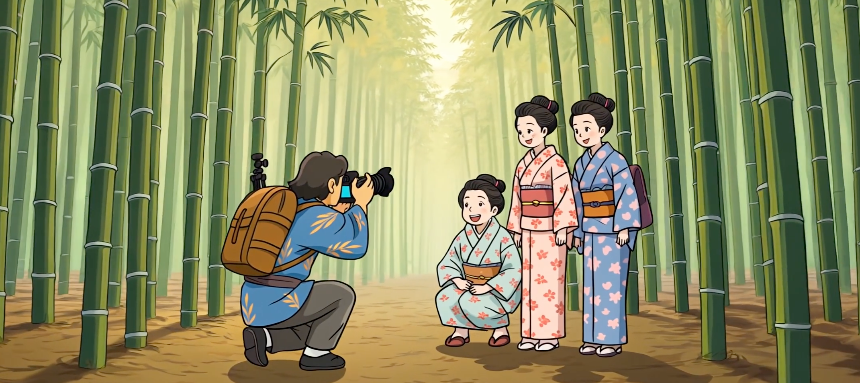
I see this play out constantly. Couples have told me they didn't even notice themselves relaxing until they were walking through Arashiyama's bamboo forest. At that point, they weren't thinking about smiling or posing. They were focused on not stepping off the path. That distraction is exactly what produces a relaxed, natural expression in a photo.
6. Give Yourself Time to Breathe
Every session has pauses built in. Use them to breathe, drink some water, and think about something other than how you look. Photos taken right after a genuine break are almost always noticeably different: looser shoulders, less tension in the jaw, smiles that look earned instead of held.
7. Reconnect With What You're Actually There For
Before your session, remember why you booked it. An engagement? A family trip? A milestone worth marking? Whatever it is, reconnect with that reason. The moment you lose sight of it, the nerves creep back in.
I've shot proposals where the couple started out visibly stressed, and then they remembered what the day actually meant. Their entire demeanor changed within seconds, and those moments were almost always the best of the entire session.
Here's something nobody tells you going in: the fear of looking unattractive in photos is often the exact thing that makes photos look unattractive. It's a closed loop. The way out isn't trying harder to "be natural," since fighting the tension just tightens it further. It's giving yourself something else to engage with besides the camera.
What to Do Before and During Your Session
Before:
Wear clothes that make you feel comfortable and confident, not clothes chosen specifically "for photography"
Arrive 10 to 15 minutes early to explore the area
Remind yourself why you booked this session
Take three slow breaths before we start shooting
During:
Don't stare at me, stare at the person next to you
Move. Walk, turn, run, don't freeze
If you take a break, use it to actually reset, not to check your phone
I'm shooting at 30 frames per second. One awkward blink isn't a disaster
Why This Typically Fails
Most of the time, clients struggle because they're working hard to control their nervous energy by controlling their pose. I've lost count of how many people I've worked with whose shoulders locked up, whose breathing paused, and whose smile got stuck in place a few seconds too long. On camera, all of that reads as exactly what it is: performance, not presence.
The second common mistake is treating the location like a backdrop instead of an experience. Clients who rush through Asakusa checking off a list of "must-have" shots, all while trying to capture every possible angle, tend to end up with technically fine but emotionally flat photos. Families and couples who instead slow down and actually enjoy a real moment together, while I happen to be there with a camera, are the ones who end up with images they actually want to frame.
Frequently Asked Questions Question: I'm naturally shy. Can I still get good photos?
Answer: Yes, and some of my favorite sessions have been with shy clients. Shyness usually resolves once you stop focusing on the camera and start focusing on the person you're with. Early arrival and movement help far more than any pep talk I could give you.
Question: How long does it usually take to warm up during a session?
Answer: Most clients relax noticeably within the first 15 to 20 minutes, especially when we start with a walking segment rather than posed shots. That's why I build movement into the beginning of every session rather than saving it for later.
Question: Should I practice poses beforehand?
Answer: I'd actually recommend against it. Rehearsed poses tend to look rehearsed. Practicing genuine relaxation, like a few slow breaths, works better than practicing a specific angle.
Question: What if I have a bad hair day or feel self-conscious that day?
Answer: This happens more often than you'd think, and it's rarely as visible in the final photos as people fear. Connection and genuine expression carry a photo far more than any single detail of appearance on a given day.
Question: Do you edit out awkward expressions, or do I need to get it right in the moment?Answer: Shooting at a high burst rate means we're rarely relying on one single moment. Across a two-hour session we'll have hundreds of frames to choose from, so an off moment here or there isn't a problem.
Ready to Create Your Japan Memories?
If you're planning a photo session in Tokyo, Kyoto, Osaka, or anywhere across Japan, I'd love to help you create something you'll actually want to look at years from now. Whether it's a couple session, family portraits, or a milestone celebration, my job is to make the experience comfortable enough that you forget I'm even holding a camera.
Contact me for a free consultation and let's talk about what your session should look like.


Comments